GDPR-Compliant Chatbot: What Businesses Need to Know
Last updated: March 2026 | Reading time: 14 minutes
AI chatbots and AI phone agents are revolutionising customer service – but with automation come new data protection challenges. Every conversation a chatbot has with a customer generates personal data: names, email addresses, phone numbers, health information for medical practices, or financial data for insurance companies. For businesses operating in the EU, the question is not whether they need to comply with data protection law, but how to implement it correctly.
The good news: a GDPR-compliant chatbot is not a contradiction – provided you choose the right provider and observe the essential requirements. In this guide, we explain all relevant data protection aspects, from the legal bases through data processing agreements to the new EU AI Act. At the end, you will find a practical checklist to evaluate any chatbot provider for GDPR compliance.
Table of Contents
- Why Data Protection Matters for Chatbots
- What Data Does a Chatbot Process?
- GDPR Fundamentals for Chatbots
- The 7-Point Checklist for GDPR-Compliant Chatbots
- Data Processing Agreement (DPA): What You Need to Know
- EU AI Act: The New AI Regulation and Its Impact
- Server Location and Data Transfers to Third Countries
- Special Requirements for Sensitive Industries
- Chatbyte: GDPR Compliance as a Core Principle
- Frequently Asked Questions (FAQ)
Why Data Protection Matters for Chatbots
The importance of data protection for AI chatbots can be summarised in three dimensions: legal obligation, financial risk, and customer trust.
From a legal perspective, the situation is clear: the General Data Protection Regulation (GDPR) applies to every organisation that processes personal data of EU residents – and a chatbot does exactly that with every interaction. GDPR violations can result in fines of up to EUR 20 million or 4% of annual global turnover, whichever is higher. European data protection authorities have increasingly targeted AI applications in recent years.
The financial risk extends beyond fines, however. A data protection incident – such as a leak of customer conversations or unauthorised sharing of data with third parties – can cause significant reputational damage. In an industry where trust is the most important asset, a single incident can undo years of relationship building.
At the same time, data protection is a competitive advantage. Studies show that over 70% of European consumers consider how a service provider handles their data when making purchasing decisions. A chatbot that operates transparently and in compliance with GDPR strengthens trust and can demonstrably increase conversion rates.
What Data Does a Chatbot Process?
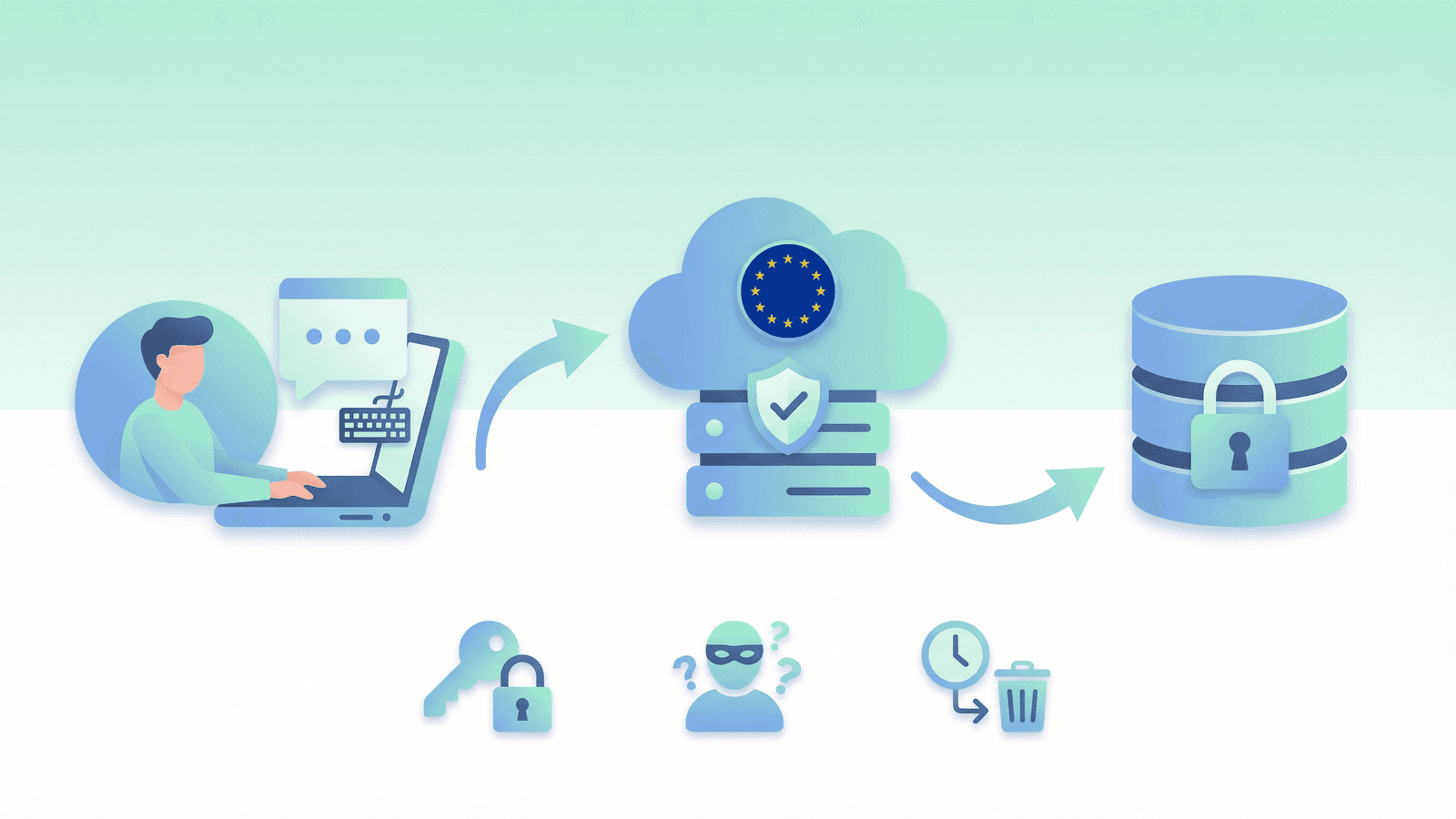
To properly assess data protection requirements, you first need to understand what data a chatbot typically processes. The scope is broader than many businesses initially assume.
Data directly entered by the user includes everything the customer communicates via chat or phone: name, email address, phone number, address, but also descriptions of their concern that may contain sensitive information – such as health complaints for a medical practice or damage descriptions for an insurance company.
Automatically captured technical data is generated with every interaction: the user's IP address, browser and device information, conversation timestamps, geolocation data, and session IDs. For phone agents, the caller's phone number and potentially voice recordings are added.
Derived and processed data is created by the AI processing itself: sentiment analyses, classification of the concern, extracted entities (appointments, product names, order numbers), and conversation summaries.
Data Category | Examples | GDPR Relevance |
|---|---|---|
Contact data | Name, email, phone, address | Personal data (Art. 4 GDPR) |
Conversation content | Inquiries, complaints, concerns | Personal data |
Health data | Symptoms, diagnoses, medications | Special categories (Art. 9 GDPR) |
Financial data | Account numbers, claim amounts | Personal data |
Technical data | IP address, browser, device ID | Personal data |
AI-generated data | Sentiment, classification | Potentially personal |
GDPR Fundamentals for Chatbots
The GDPR sets six core requirements for the processing of personal data, all of which apply to chatbots. Understanding these principles is the foundation for any GDPR-compliant chatbot implementation.
Lawfulness (Art. 6 GDPR). Every data processing operation requires a legal basis. For chatbots, three typically apply: the user's consent (Art. 6(1)(a)), contract performance (Art. 6(1)(b)) – for example, when the chatbot processes an order – or the company's legitimate interest (Art. 6(1)(f)) in efficient customer service.
Purpose limitation (Art. 5(1)(b)). Data may only be processed for the purpose for which it was collected. If a customer gives the chatbot their email address to receive an appointment confirmation, that address may not be used for newsletter marketing without further consent.
Data minimisation (Art. 5(1)(c)). Only data that is actually necessary for the respective purpose may be collected. A chatbot that asks for a date of birth for a restaurant reservation violates this principle.
Storage limitation (Art. 5(1)(e)). Personal data must be deleted once the purpose of processing has been fulfilled. Chatbot conversations should therefore not be stored indefinitely – an automatic deletion concept is required.
Transparency (Art. 13/14 GDPR). Users must be informed before data collection about what data is collected, for what purpose, on what legal basis, and how long it will be stored. For chatbots, this is typically done via a privacy notice at the beginning of the conversation or a link to the privacy policy.
Data subject rights (Art. 15–22 GDPR). Users have the right to access, rectification, erasure, restriction of processing, data portability, and objection. Your chatbot provider must be technically capable of implementing these rights – for example, through export or deletion of individual conversations.
The 7-Point Checklist for GDPR-Compliant Chatbots
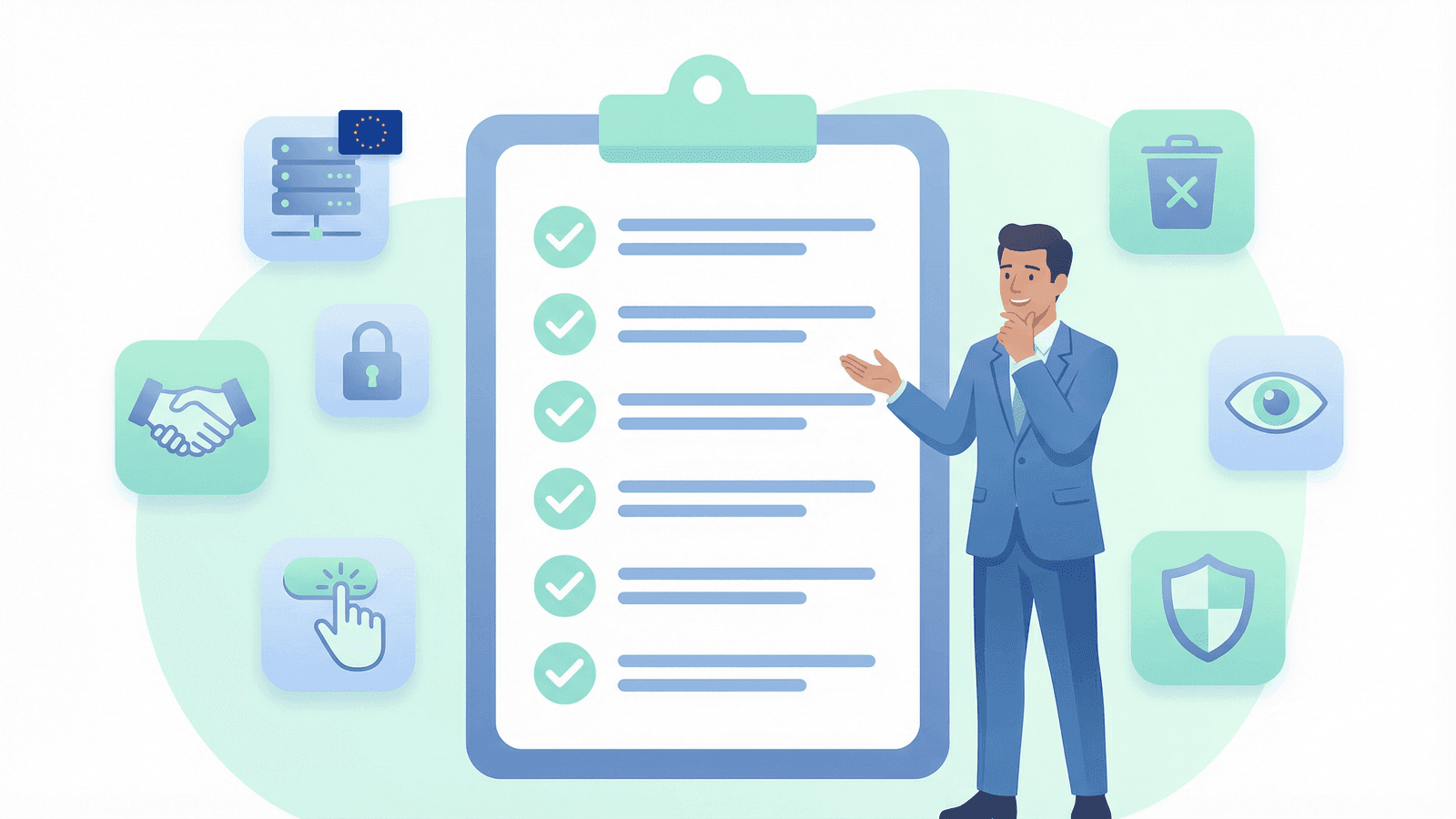
The following checklist summarises the seven most important requirements that a chatbot provider must meet to be GDPR-compliant. Use this list when evaluating providers.
1. EU Server Location
All personal data must be stored and processed on servers within the EU or EEA. Many US-based chatbot providers store data in the USA by default – this is problematic following the ECJ's Schrems II ruling and requires additional safeguards. The safest solution is a provider that exclusively uses EU servers.
2. Data Processing Agreement (DPA)
When an external chatbot provider processes personal data on your behalf, a DPA under Art. 28 GDPR is legally mandatory. Without a DPA, you as the data controller are liable – regardless of whether an actual data protection breach occurs.
3. Encryption
All data must be encrypted both in transit (Transport Layer Security / TLS) and at rest (Encryption at Rest). Check whether the provider uses at least TLS 1.2 or higher for data transmission and AES-256 for storage.
4. Consent Management
Users must be informed before data collection and – depending on the legal basis – be able to give their consent. For website chatbots, this means a privacy notice must be displayed before or at the beginning of the conversation. For phone agents, the caller must be informed at the beginning of the call that they are speaking with an AI.
5. Deletion Concept and Retention Periods
There must be a clear concept for when and how conversation data is deleted. Ideally, the provider offers configurable retention periods (e.g., automatic deletion after 30, 90, or 365 days) and the ability to immediately delete individual conversations on request (right to erasure, Art. 17 GDPR).
6. No Use for AI Training
A critical point that many businesses overlook: is your customers' conversation data used by the provider to train or improve its AI model? If so, this constitutes a change of purpose that requires a separate legal basis. Many US providers (including OpenAI with direct API use) reserve this right. Ensure the provider contractually guarantees that your data will not be used for their own training purposes.
7. Technical and Organisational Measures (TOMs)
The provider must be able to demonstrate appropriate TOMs: access controls, logging, regular security audits, backup concepts, and incident response plans. Ideally, the provider holds ISO 27001 certification or a comparable security certificate.
Checklist Item | Mandatory | What to Look For |
|---|---|---|
EU server location | Yes | Exclusively EU/EEA, no US sub-processors |
DPA available | Yes (legally required) | Art. 28 GDPR, TOMs as annex |
Encryption | Yes | TLS 1.2+, AES-256, end-to-end |
Consent management | Yes | Privacy notice before conversation |
Deletion concept | Yes | Configurable periods, individual deletion |
No AI training with data | Strongly recommended | Contractual guarantee |
TOMs documented | Yes | ISO 27001 or comparable |
Data Processing Agreement (DPA): What You Need to Know
The Data Processing Agreement is the central document for GDPR compliance when using external chatbot services. Without a DPA, using an external chatbot provider is unlawful – even if the provider itself meets all data protection standards.
A complete DPA under Art. 28 GDPR must address the following points: the subject matter and duration of processing, the nature and purpose of processing, the types of personal data processed, the categories of data subjects, the obligations and rights of the controller, technical and organisational measures, and sub-processors.
Practical tip: Reputable chatbot providers proactively make the DPA available – often as a download on their website. If a provider does not offer a DPA or responds evasively when asked, this is a clear warning sign.
EU AI Act: The New AI Regulation and Its Impact
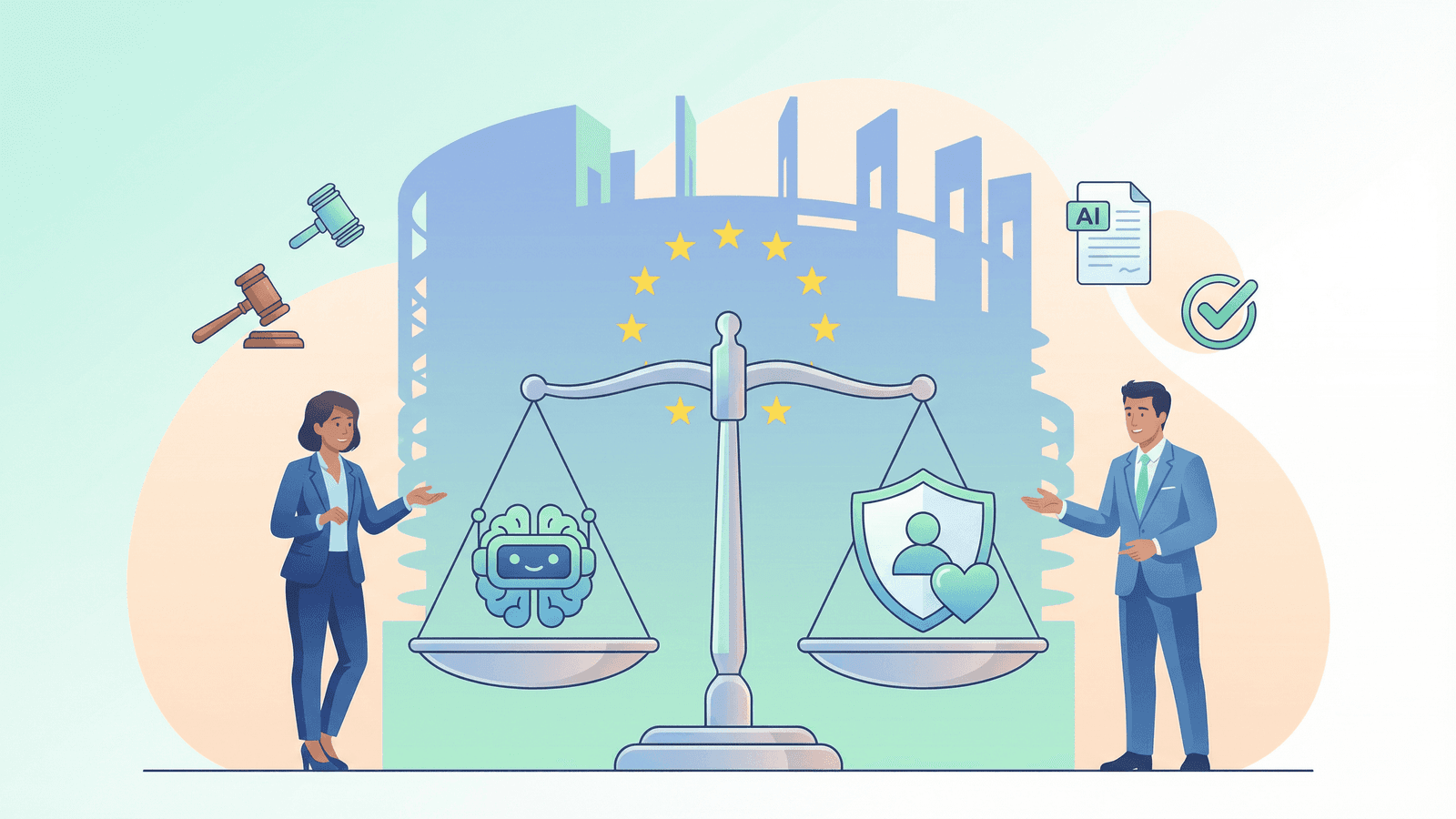
Since 2 February 2025, the EU AI Act (Regulation (EU) 2024/1689) has been in force – the world's first comprehensive AI regulation. For chatbot and phone agent providers and their customers, the AI Act introduces additional requirements beyond the GDPR.
Risk classification. The AI Act classifies AI systems into four risk categories: unacceptable risk (prohibited), high risk, limited risk, and minimal risk. Most customer service chatbots and phone agents fall into the limited risk category – with one important obligation: the transparency requirement.
Transparency requirement (Art. 50 AI Act). AI systems that interact directly with humans must disclose that the user is communicating with an AI. For chatbots, this means a notice must appear at the beginning of every conversation indicating it is an AI-powered assistant. For phone agents, the caller must be informed at the start of the call that they are speaking with an AI.
High-risk exceptions. In certain industries, chatbots may be classified as high-risk AI – for example, in healthcare (if the chatbot provides medical recommendations) or in the financial sector (if it influences credit decisions). Significantly stricter requirements apply to high-risk AI: risk management systems, quality management systems, technical documentation, logging, and human oversight.
AI Act Category | Examples | Requirements |
|---|---|---|
Minimal risk | Spam filters, recommendation systems | No special obligations |
Limited risk | Customer service chatbots, phone agents | Transparency requirement (AI labelling) |
High risk | Medical AI, credit scoring | Comprehensive compliance requirements |
Unacceptable risk | Social scoring, manipulative AI | Prohibited |
Server Location and Data Transfers to Third Countries
The question of server location is one of the most critical aspects when choosing a chatbot provider. The ECJ's Schrems II ruling in 2020 invalidated the EU-US Privacy Shield and significantly complicated the transfer of personal data to the USA.
While the EU-US Data Privacy Framework has been in place since July 2023 as a successor, its long-term legal certainty is disputed among legal experts. Many data protection specialists expect a "Schrems III" ruling that could also overturn this framework. For businesses that want to be on the safe side, there is only one recommendation: choose a provider that processes data exclusively in the EU.
The problem with many chatbot providers: even if the provider itself is based in the EU, it may use US-based sub-processors. Particularly relevant are the AI model providers: if the chatbot uses a model from OpenAI, Anthropic, or Google, conversation data may be transferred to US servers – even if the chatbot provider operates its own servers in the EU.
Special Requirements for Sensitive Industries
Certain industries are subject to additional data protection requirements that go beyond the general GDPR. If you operate in one of these sectors, you need to be particularly careful when selecting a chatbot.
Healthcare. Health data belongs to the "special categories of personal data" under Art. 9 GDPR and enjoys the highest level of protection. Its processing is fundamentally prohibited and only permissible under strict exceptions.
Financial services. In addition to the GDPR, requirements from financial regulators apply, including comprehensive information risk management and strict requirements for outsourcing arrangements.
Legal professionals. For lawyers and tax advisors, special professional confidentiality obligations apply. The use of a chatbot must not violate these duties.
Industry | Additional Requirement | Relevant Regulation |
|---|---|---|
Healthcare | Special protection for health data | Art. 9 GDPR |
Financial services | IT security requirements | DORA, MiFID II |
Legal professionals | Professional confidentiality | National bar regulations |
Public administration | Special outsourcing requirements | National data protection laws |
Chatbyte: GDPR Compliance as a Core Principle
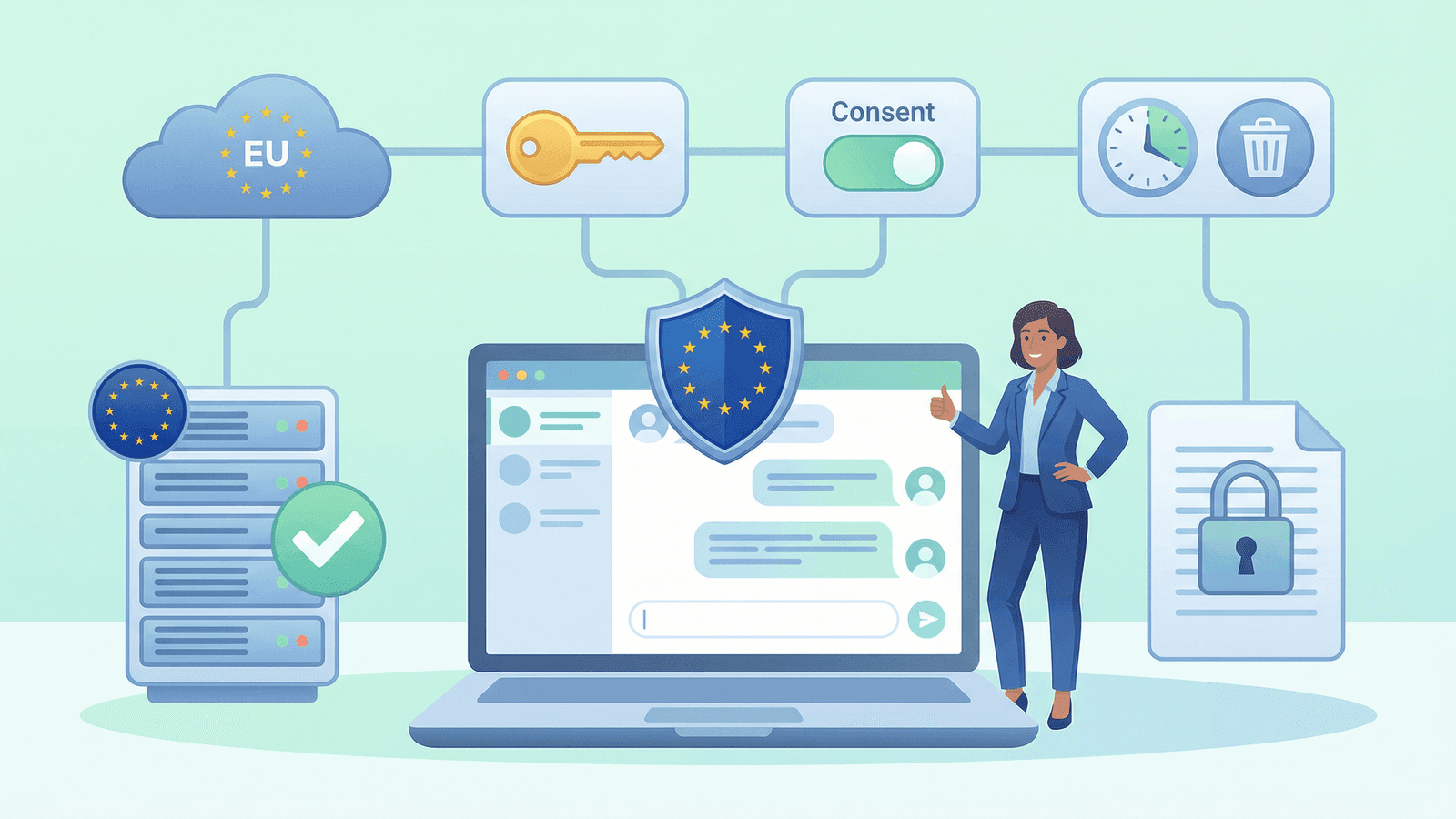
Chatbyte was built from the ground up for the European market – data protection is not an afterthought but a core architectural principle. Here is how Chatbyte meets all seven points of the GDPR checklist.
100% EU hosting. All data is stored and processed exclusively on servers in the European Union. No data transfer to third countries takes place – not even to US-based sub-processors. AI models run on EU-hosted instances.
DPA immediately available. Chatbyte provides a complete Data Processing Agreement under Art. 28 GDPR that meets all legal requirements. The DPA can be concluded directly via the dashboard – no waiting times or legal coordination needed.
End-to-end encryption. All data is encrypted with TLS 1.3 in transit and AES-256 at rest. Conversation data is not accessible in plain text even to Chatbyte employees.
Integrated consent management. The chatbot automatically displays a configurable privacy notice at the beginning of every conversation. The phone agent informs the caller at the start that they are speaking with an AI.
Configurable retention periods. Businesses can set individual retention periods (30, 90, 180, or 365 days). Individual conversations can be manually deleted at any time. On request, all data of a specific user can be exported or deleted (data subject rights).
No use for AI training. Chatbyte contractually guarantees that customer data is never used for training its own or third-party AI models. Your data belongs to you – full stop.
ISO 27001-compliant security measures. Chatbyte implements technical and organisational measures at ISO 27001 level: access controls, logging, regular penetration tests, backup concepts, and documented incident response processes.
GDPR Requirement | Chatbyte | Typical US Provider |
|---|---|---|
Server location | EU (exclusively) | USA (default) |
DPA available | Yes, instant via dashboard | Often only on request |
Encryption | TLS 1.3 + AES-256 | TLS 1.2 + variable |
Consent management | Integrated, configurable | Often not available |
Deletion concept | Configurable periods | Often unlimited storage |
No AI training | Contractually guaranteed | Often not excluded |
TOMs documented | ISO 27001-compliant | Variable |
Frequently Asked Questions
Do I need consent from my customers to use a chatbot?
It depends on the legal basis. If the chatbot serves contract performance (e.g., order status queries), Art. 6(1)(b) GDPR may suffice as a legal basis. For processing beyond this (e.g., user behaviour analysis), consent is generally required. In any case, you must transparently inform the user about the data processing.
What happens if my chatbot provider stores data in the USA?
Data transfer to the USA is generally possible under the EU-US Data Privacy Framework if the US provider is certified. However, the long-term legal certainty of this framework is disputed. For maximum security, we recommend a provider with exclusive EU hosting.
Do I need to involve my Data Protection Officer?
Yes, if your organisation has a DPO, they should be involved in the introduction of a chatbot. They can conduct the Data Protection Impact Assessment (DPIA), review the DPA, and ensure all requirements are met.
Is a Data Protection Impact Assessment (DPIA) required?
A DPIA under Art. 35 GDPR is required when data processing poses a high risk to the rights and freedoms of data subjects. For chatbots processing sensitive data (health data, financial data) or involving systematic monitoring, a DPIA is generally mandatory. For simple customer service chatbots without sensitive data, it is recommended but not mandatory.
May I record chatbot conversations?
Recording chatbot conversations (especially phone calls) is subject to strict rules. For phone calls, the caller must be informed at the beginning and give their consent. For text chatbots, conversations are stored by default – here, a transparent privacy notice with storage duration is sufficient.
What must be included in my privacy policy?
Your privacy policy must include a section on the chatbot covering: the name and contact details of the chatbot provider, purpose of data processing, legal basis, types of data processed, storage duration, recipients of data (processors), reference to data subject rights, and where applicable, information on data transfers to third countries.
Conclusion: GDPR Compliance Is Not an Obstacle but an Advantage
The GDPR sets high standards for the use of AI chatbots and phone agents – but it does not make their use impossible. On the contrary: a GDPR-compliant chatbot is a trust signal for your customers and a competitive advantage over providers that neglect data protection.
The key lies in choosing the right provider. With a European provider like Chatbyte that understands data protection as a core principle and meets all requirements of the GDPR and the EU AI Act, you can introduce AI-powered customer service without compromising on data protection.
This article is for general information purposes and does not constitute legal advice. For specific implementation in your organisation, we recommend consulting a data protection officer or specialised lawyer.
Chatbyte – The GDPR-compliant multichannel AI platform. www.chatbyte.ai