What Is an AI Phone Agent? Everything You Need to Know
Last updated: March 2026 | Reading time: 12 minutes
The phone rings – but no one is there to answer. For many businesses, this is daily reality: tradespeople are on-site, doctors are with patients, restaurant staff are in the kitchen. Every missed call is a potentially lost customer. This is exactly where the AI phone agent comes in – a technology that has fundamentally transformed business communication over the past two years.
But what exactly is an AI phone agent? How does the underlying technology work? And which businesses benefit most from the investment? In this comprehensive guide, we answer all your questions – from the basic principles through concrete use cases to a provider comparison.
Table of Contents
- Definition: What Is an AI Phone Agent?
- How Does an AI Phone Agent Work? The Technology Explained
- AI Phone Agent vs. Traditional Voicemail
- The 6 Key Benefits
- Use Cases: Who Benefits Most?
- What Can an AI Phone Agent Actually Do?
- What to Look for When Choosing a Provider
- Chatbyte: AI Phone Agent and Chatbot on One Platform
- Frequently Asked Questions (FAQ)
Definition: What Is an AI Phone Agent?
An AI phone agent is artificial intelligence-powered software that automatically answers incoming phone calls and conducts natural-language conversations with callers. Unlike a traditional voicemail system that merely records a message, an AI phone agent understands the caller's intent, answers questions, captures information, and can independently execute actions – such as booking an appointment, initiating a call transfer, or sending a summary via email.
An AI phone agent is essentially a virtual employee who handles your phone – with the difference that it never gets sick, never needs a break, and can handle hundreds of calls simultaneously.
The technology is also known by various other names: virtual receptionist, voice AI, AI telephone assistant, AI receptionist, or business voice assistant. They all refer to the same core principle: an AI that conducts human-like conversations over the phone.
The crucial difference from older systems like IVR (Interactive Voice Response), where callers had to navigate through keypress menus ("Press 1 for sales, 2 for support..."), lies in the naturalness of the conversation. Modern AI phone agents understand free speech, respond to follow-up questions, and adapt to the flow of conversation – almost as if a real person were on the other end of the line.
How Does an AI Phone Agent Work? The Technology Explained
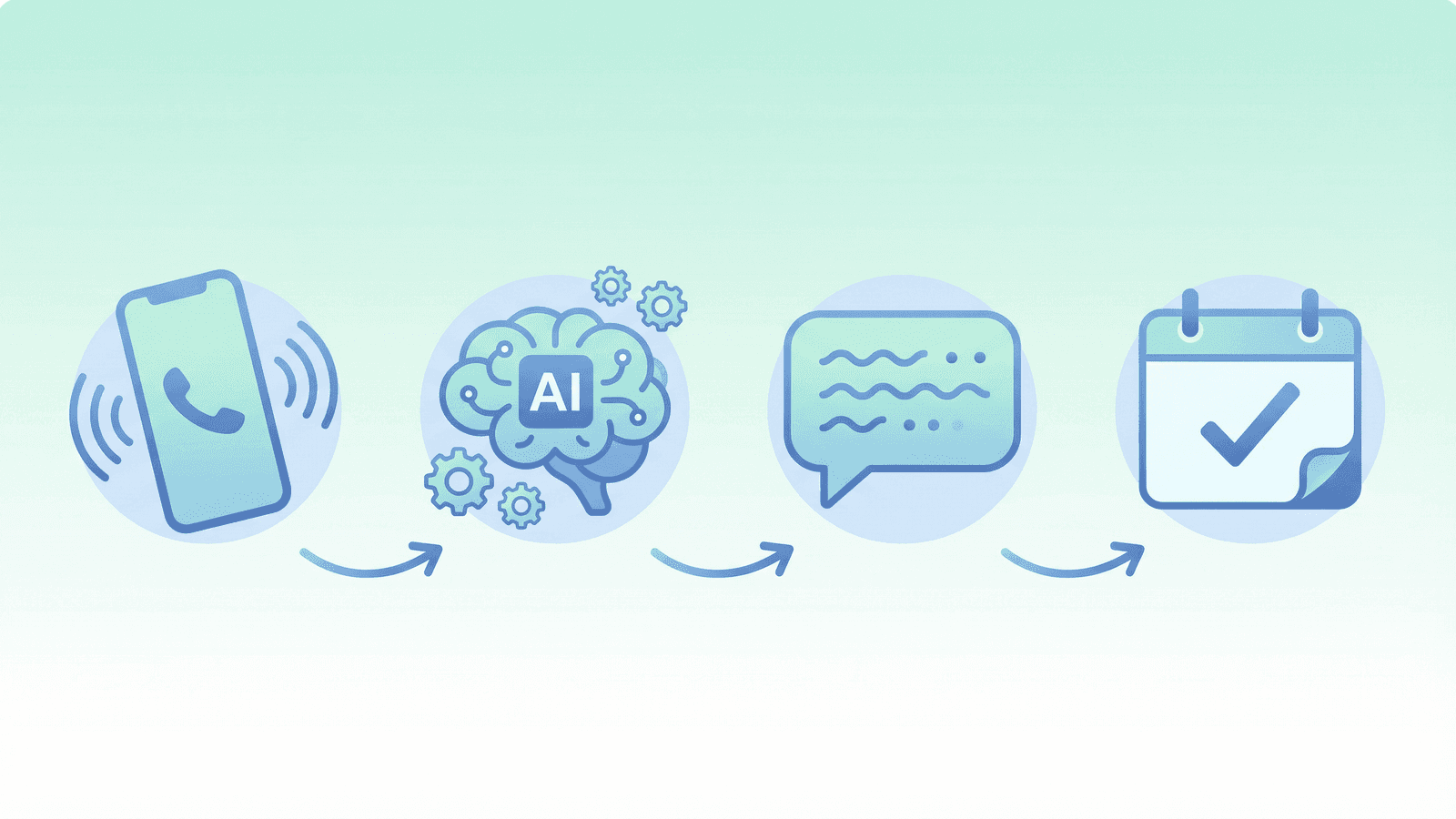
Behind an AI phone agent lies a complex interplay of several technologies working together in real time. The entire process runs in four steps – all within fractions of a second.
Step 1: Speech Recognition (Speech-to-Text). When a caller speaks, the speech recognition engine converts the spoken words into text. Modern systems use neural networks that can reliably process dialects, accents, and background noise. Recognition accuracy in current systems exceeds 95%, even with complex technical terminology.
Step 2: Understanding and Processing (Natural Language Understanding). The recognised text is analysed by a large language model (LLM). The model identifies the caller's intent – do they want to book an appointment? Do they have a complaint? Do they need information? – and matches the request against the company's stored knowledge base. This is where the real breakthrough of recent years lies: thanks to models like GPT-4o, AI phone agents can now understand ambiguous, complex, or unexpected requests and respond meaningfully.
Step 3: Generate Response and Execute Action. Based on its understanding of the request, the AI formulates an appropriate response. Simultaneously, it can trigger actions: enter an appointment in the calendar, send a summary email, transfer the call to a specific employee, or create a CRM ticket. These actions are executed via APIs to the respective systems.
Step 4: Speech Output (Text-to-Speech). The generated text response is converted into natural-sounding speech by a speech synthesis engine and read to the caller. Modern TTS systems sound so natural that many callers cannot tell they are speaking with an AI. The voice can be customised in pitch, speed, and style to match the company's brand.
This entire cycle – from the caller's spoken word to the AI's spoken response – typically takes less than one second. This makes the conversation feel natural and fluid, without awkward pauses.
Technology Layer | Function | Typical Latency |
|---|---|---|
Speech-to-Text (STT) | Convert speech to text | 200–400 ms |
Natural Language Understanding | Recognise intent, understand context | 100–300 ms |
Action Execution | Book appointment, send email, transfer | 50–200 ms |
Text-to-Speech (TTS) | Convert text to natural speech | 100–200 ms |
Total Latency | From speaking to response | < 1 second |
AI Phone Agent vs. Traditional Voicemail
Many business owners ask: "Isn't a regular voicemail enough?" The short answer: No – and the difference is enormous. A traditional voicemail is passive: it plays a greeting and records a message. The caller must compress their concern into a monologue and hope someone calls back. Studies show that over 80% of callers don't leave a message on voicemail – they simply hang up and call a competitor instead.
An AI phone agent, by contrast, is active: it conducts a real conversation, asks clarifying questions, provides information, and ideally resolves the issue directly during the call. The caller feels they are speaking with a competent employee, and their problem is addressed immediately.
Feature | Voicemail | AI Phone Agent |
|---|---|---|
Conversation | None (recording only) | Real dialogues in natural language |
Answer questions | Not possible | Yes, based on knowledge base |
Book appointments | Not possible | Yes, automatically in calendar |
Call transfer | Not possible | Yes, intelligent routing by topic |
Multilingual | No | Yes, 50+ languages |
Simultaneous calls | 1 | Unlimited |
Customer experience | Frustrating | Professional and helpful |
Resolution rate | < 20% leave a message | > 90% issues resolved directly |
The 6 Key Benefits
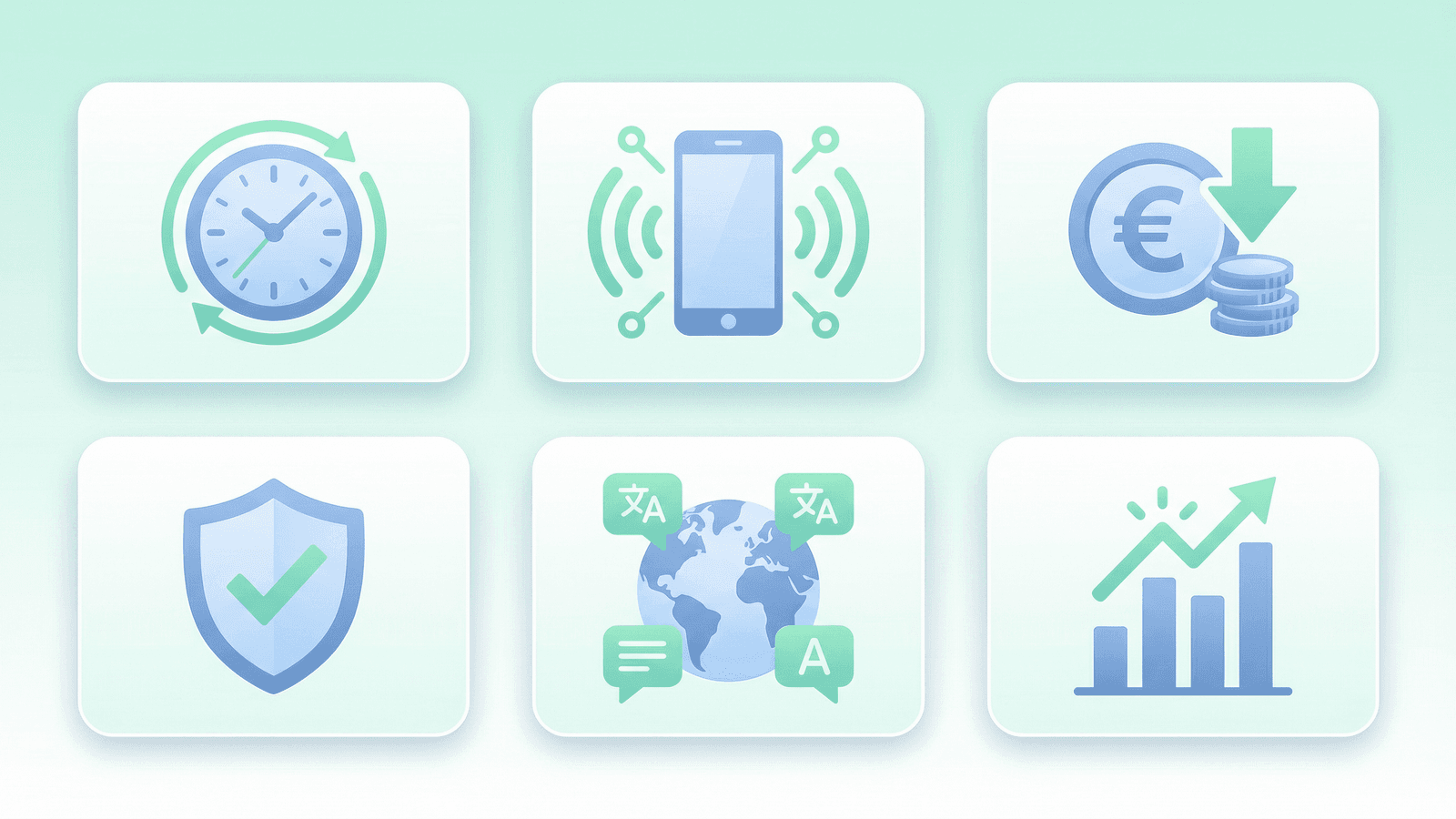
Deploying an AI phone agent delivers tangible, measurable benefits for businesses of every size. Here are the six most important advantages.
1. No Call Goes Unanswered
This is the most obvious and most impactful benefit. An AI phone agent answers every call – whether at 3 a.m., on Sunday, or while you're in a client meeting. For trades businesses, medical practices, and other companies that are frequently unavailable during the day, this translates to direct revenue growth. Industry surveys show that an average trades business loses between EUR 20,000 and 50,000 in potential revenue annually due to missed calls.
2. Professional Impression Around the Clock
Every caller is greeted immediately, warmly, and competently – regardless of time of day or workload. This conveys professionalism and strengthens trust in your business. For smaller companies that cannot afford a dedicated receptionist, this represents an enormous image boost.
3. Massive Time Savings for Your Team
Studies show that up to 60% of all incoming calls to a business concern standard questions: opening hours, directions, prices, availability. An AI phone agent answers these automatically and only forwards truly important, complex matters to your staff. This saves an average of 2–3 hours per day in phone time – time your team can use for value-adding work.
4. Cost Efficiency Compared to Staff
An AI phone agent typically costs between EUR 50 and 200 per month – a fraction of the cost of a part-time receptionist or external answering service. Yet it's available 24/7, never calls in sick, and can handle unlimited calls simultaneously. For businesses currently using an external phone service (typically EUR 200–500 per month), switching to an AI phone agent often means immediate cost savings with better performance.
5. Automatic Appointment Booking and Actions
A modern AI phone agent goes beyond answering questions. It can directly book appointments in your calendar during the conversation, capture callback requests, send information via email or SMS, and enter data into your CRM system. This eliminates manual follow-up work and significantly accelerates your processes.
6. Valuable Data and Insights
Every conversation is documented and analysed. You gain insights into which questions are asked most frequently, when most calls come in, and which topics concern your customers most. This data is invaluable for optimising your offerings, website, and marketing strategy.
Use Cases: Who Benefits Most?
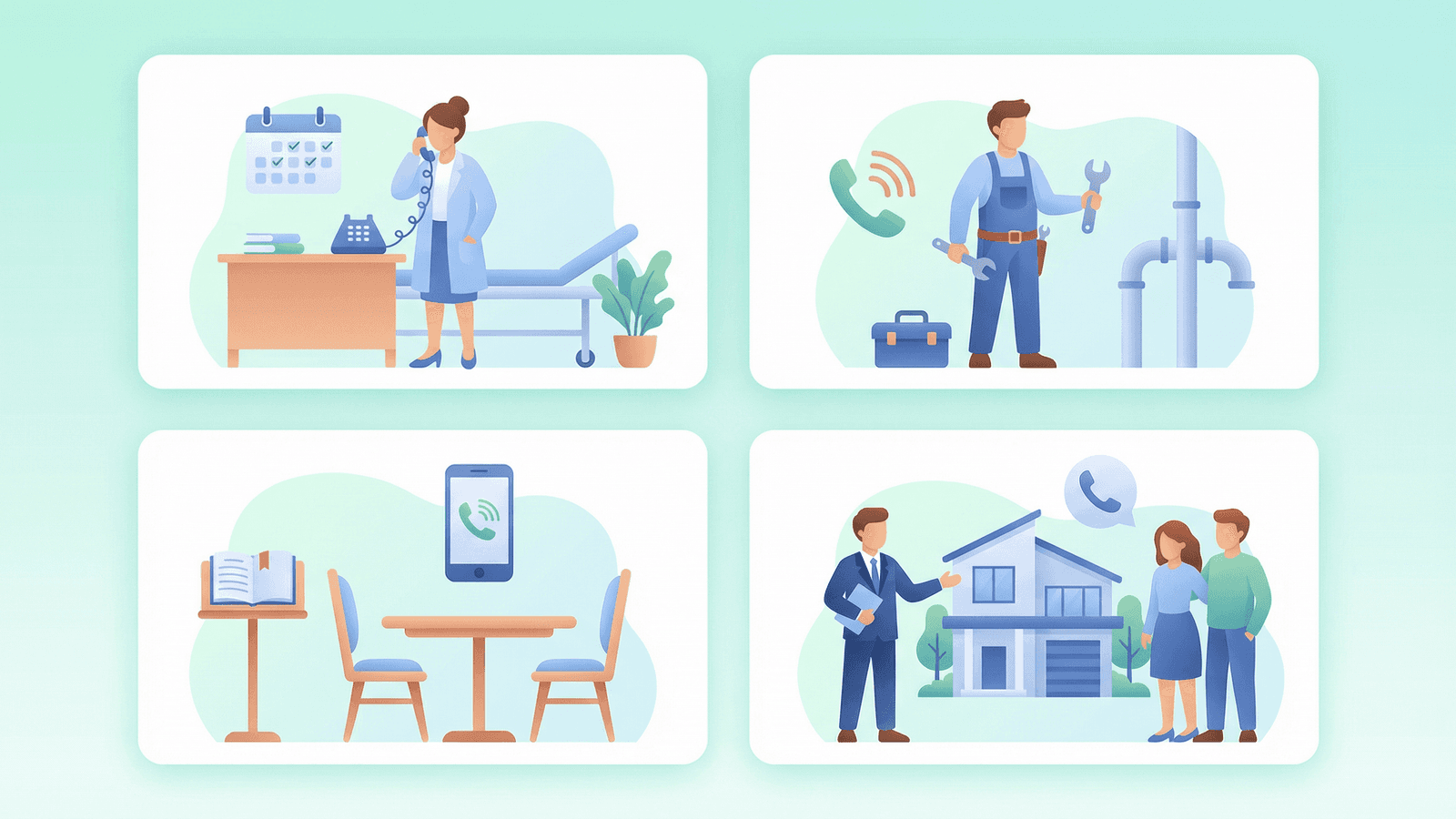
An AI phone agent is fundamentally suitable for any business that needs to be reachable by phone but cannot always be. The following industries benefit most.
Trades and Home Services
Tradespeople spend most of their day on-site and cannot answer the phone. Yet incoming calls are their most important source of new business. An AI phone agent answers every call, captures the request (burst pipe, heating maintenance, quote for bathroom renovation), assesses urgency, and books an inspection appointment if needed. For emergencies, it can immediately send an SMS to the tradesperson.
Medical and Dental Practices
Medical practices are among the businesses with the highest call volume – and the lowest availability. Patients call to schedule appointments, request prescription refills, or ask about test results. An AI phone agent can book appointments directly in the practice management system, log prescription requests, and answer general questions about office hours and services. This enormously relieves the practice team and reduces patient wait times.
Restaurants and Hotels
Reservations, menu questions, opening hours, special requests for events – the hospitality industry receives dozens of calls daily that pull service staff away from their actual work. An AI phone agent takes reservations, answers questions about the menu and allergens, and routes complex inquiries (catering, large events) to the right contact person.
Real Estate Agents
Real estate agents constantly receive inquiries about properties – often from prospects who have just seen a listing and want to know more immediately. An AI phone agent can provide property details, schedule viewing appointments, and capture the prospect's contact information for the CRM. This ensures no hot lead is lost, even when the agent is in a showing.
Law Firms and Tax Advisors
For professional service firms, telephone availability is a quality marker. An AI phone agent takes initial inquiries, captures the area of law and urgency, and schedules a consultation appointment. Existing clients can check the status of their matter or request documents.
Industry | Typical Call Volume | Primary Benefit |
|---|---|---|
Trades | 10–30 calls/day | Order intake despite being on-site |
Medical Practice | 50–150 calls/day | Appointment booking, prescription requests |
Restaurants | 20–50 calls/day | Reservations, menu questions |
Real Estate | 10–40 calls/day | Property inquiries, viewing appointments |
Law Firms | 10–30 calls/day | Initial inquiries, appointment scheduling |
E-Commerce | 20–100 calls/day | Order status, returns, product questions |
What Can an AI Phone Agent Actually Do?
The capabilities of a modern AI phone agent extend far beyond simply answering questions. Here is an overview of the most important features.
Answer questions: The phone agent accesses your knowledge base and answers questions about products, services, pricing, opening hours, directions, and much more. It can also ask complex follow-up questions to precisely understand the caller's needs.
Book appointments: Through integration with your calendar system (Google Calendar, Outlook, Calendly, industry-specific software), the agent can offer available time slots, book appointments, and send confirmation via SMS or email to the caller.
Intelligently route calls: Based on the caller's needs, the agent can transfer the call to the right employee or department. It passes along a summary of the conversation so far, so the employee is immediately up to speed.
Capture information: The agent can systematically collect information – name, contact details, concern, urgency – and forward it as a summary via email, SMS, or CRM entry.
Make outbound calls: Some AI phone agents can also proactively make calls – for appointment confirmations, reminders, satisfaction surveys, or sales follow-ups.
Communicate multilingually: Modern systems automatically detect the caller's language and switch seamlessly – ideal for businesses with international customers or in tourist regions.
What to Look for When Choosing a Provider
The AI phone agent market is growing rapidly, and quality differences between providers are significant. The following criteria will help you make the right decision.
Voice quality and naturalness: Test how natural the conversation feels. Does the AI voice sound robotic or human? Are there awkward pauses? Does the AI understand colloquial expressions and regional accents? The best systems are nearly indistinguishable from a real employee.
GDPR compliance: For the European market, data protection is non-negotiable. Check whether the provider stores data in the EU, offers a Data Processing Agreement (DPA), and whether conversation data is used for AI model training.
Integrations: An AI phone agent is only as good as its connection to your existing systems. Check whether interfaces to your calendar, CRM, helpdesk, and email system are available.
Channel breadth: The best providers don't limit themselves to phone – they additionally offer chat, WhatsApp, email, and more channels, all from one platform. This means you don't need a separate provider for each channel.
Pricing model: Most providers charge per minute (typically EUR 0.10–0.30/minute). Watch for minimum contract terms, setup fees, and hidden costs for integrations or additional features.
Setup effort: How quickly can you get started? The best platforms allow setup in under 30 minutes – without coding skills and without an IT department.
Chatbyte: AI Phone Agent and Chatbot on One Platform
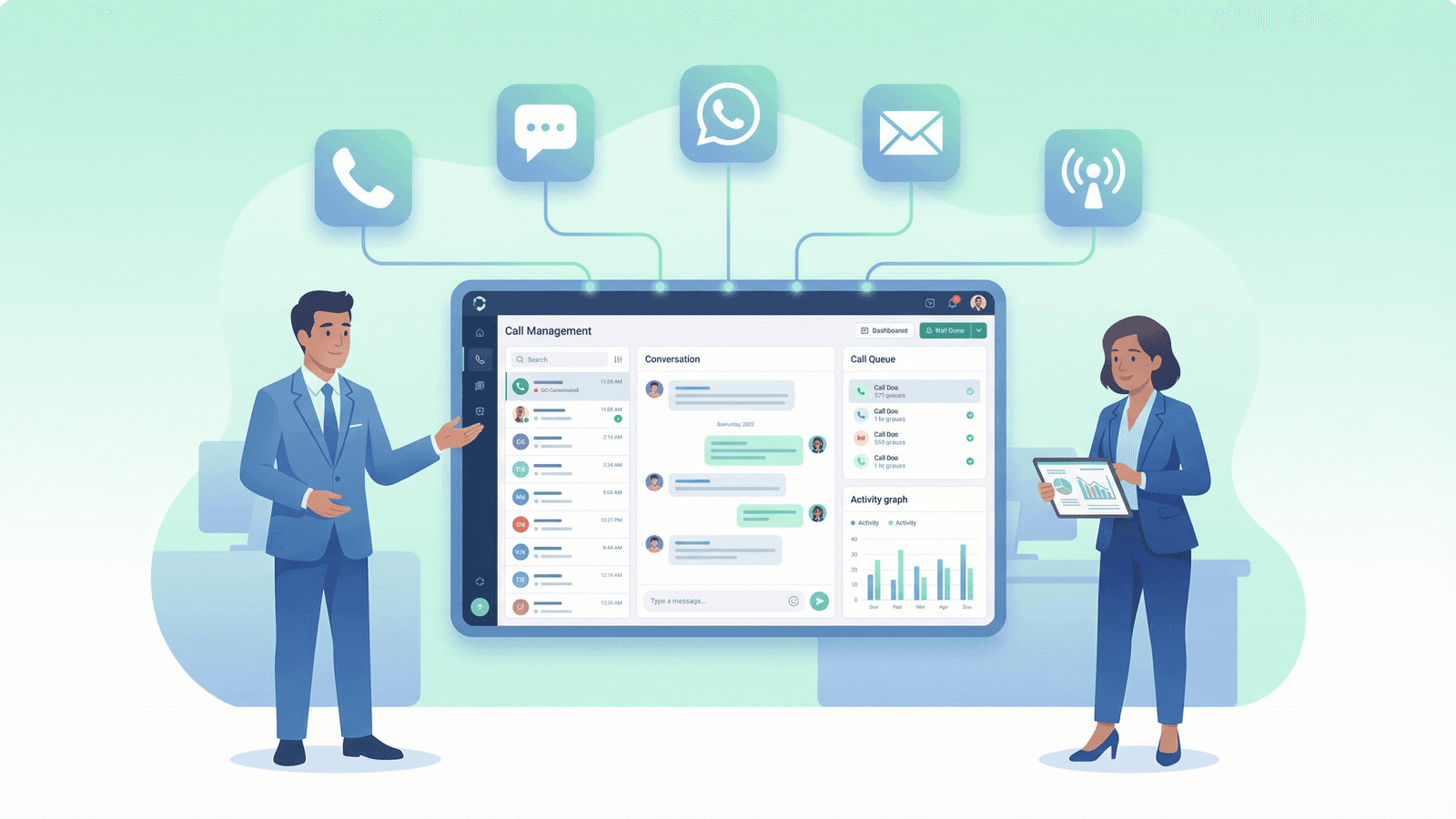
Chatbyte stands out as the only provider on the European market that combines an AI phone agent and AI chatbot on a single platform. This means you train your knowledge base once and use it across all channels – phone, website chat, WhatsApp, email, and RCS.
Multichannel from one platform. While other providers offer either phone or chat only, Chatbyte covers all relevant communication channels. Your customer can send a WhatsApp message in the morning, call at noon, and ask a question via website chat in the evening – and receives consistent, high-quality answers from the same knowledge base everywhere.
Official RCS partner. Chatbyte is an official partner of Vodafone, Telekom, 1&1, and Telefonica for RCS Business Messaging. RCS is the successor to SMS and enables rich, interactive messages directly in the smartphone's native messaging app – a channel that no other AI phone agent provider in Europe offers.
GDPR-compliant and EU-hosted. All data is stored and processed exclusively in the EU. Chatbyte provides a full Data Processing Agreement and meets all requirements of the GDPR and the EU AI Act.
Industry-specific solutions. Chatbyte offers pre-configured solutions for the most common industries – trades, medical practices, restaurants, real estate, and more. This significantly accelerates setup, as industry-specific conversation flows and knowledge base templates are already prepared.
Fair pricing. The AI phone agent is available from EUR 0.20 per minute, the AI chatbot from EUR 45 per month. No hidden costs, no minimum contract term, free trial included.
Feature | Chatbyte | Fonio | HalloPetra | Retell AI |
|---|---|---|---|---|
AI Phone Agent | Yes | Yes | Yes | Yes |
AI Chatbot | Yes | No | No | No |
Yes | No | No | No | |
Yes | No | No | No | |
RCS Business Messaging | Yes | No | No | No |
GDPR-compliant | Yes | Yes | Yes | Limited |
Industry solutions | Yes | Yes | Yes (Trades) | No |
Phone pricing | From EUR 0.20/min | From EUR 0.19/min | From EUR 0.49/min | From $0.07/min |
Try Chatbyte AI Phone Agent now
Frequently Asked Questions
How much does an AI phone agent cost?
Costs vary by provider and usage volume. Most providers charge per conversation minute, typically between EUR 0.10 and 0.50 per minute. Some also offer monthly flat rates. Chatbyte charges from EUR 0.20 per minute with no base fee for the phone agent. For a business with an average of 20 calls per day and a mean conversation duration of 2 minutes, monthly costs come to approximately EUR 240 – significantly less than a part-time receptionist.
Can callers tell they're speaking with an AI?
With high-quality systems, the difference is barely noticeable. Modern text-to-speech engines produce natural-sounding voices with realistic intonation and speech melody. Nevertheless, we recommend informing callers at the beginning of the conversation that they are connected with an AI assistant, for transparency reasons. This is also legally required in some EU countries.
Can an AI phone agent book appointments?
Yes, this is one of the core features. Through integration with common calendar systems (Google Calendar, Outlook, Calendly, industry-specific software), the agent can offer available time slots, book appointments, and send a confirmation to the caller. With Chatbyte, this also works via WhatsApp and the website chat.
Does an AI phone agent work in languages other than English?
Yes, modern AI phone agents support numerous languages. Chatbyte supports over 50 languages and can automatically detect the caller's language and respond accordingly. This is particularly valuable for businesses in tourist regions or with an international customer base.
Do I need a new phone number?
Typically not. Most providers work with call forwarding: when you're unavailable (or by default), calls are forwarded to the AI phone agent's number. Your existing business number remains unchanged. Alternatively, you can also set up a new number and use it in parallel.
How quickly can I set up an AI phone agent?
With modern platforms like Chatbyte, basic setup takes under 30 minutes: upload your knowledge base (website URL or documents), configure voice and greeting, set up call forwarding – done. The subsequent fine-tuning based on the first real conversations typically takes 1–2 weeks.
What happens when the AI can't answer a question?
A good AI phone agent recognises its limitations. When it cannot answer a question or the caller explicitly requests a human contact, it seamlessly transfers the call to an employee – including a summary of the conversation so far. If no employee is available, it captures the contact details and concern and arranges a callback.
This article is regularly updated. Last update: March 2026. All information without guarantee.
Chatbyte – The multichannel AI platform for your customer service. www.chatbyte.ai